The RAG Book
Last spring I decided to build a real multi-agent system for GTM — sourcing intel, running tech recon, mapping sales plays, drafting outreach. The kind of system that should work well with AI.
A few hours in, I had output. Fast. It was also worthless.
The intel and recon agents weren’t hitting their APIs - one to a web-scraper, the other to a data source. They were hallucinating the data. Everything downstream — the plays, the targets, the emails — was broken or built on fiction. A pipeline of confident nonsense.
So I started looking into RAG and orchestration.
What I found was noise. Vectorization, embeddings, chunking, reranking, evals, governance. Courses at $3,000 each. Separate courses for RAG, agents, and evals, as if they were different disciplines instead of one system.
Then I overheard something that cut through it. On a flight, a serious AI engineer was explaining vectorization to his nephew — stripped down to its function. What it does. Why it exists. When not to use it.
That was the unlock. Every one of these concepts has a simple core underneath the jargon. Frame them by function instead of by buzzword and the whole thing resolves into something a thinking person can hold in their head.
So I wrote the book from the primitives up.
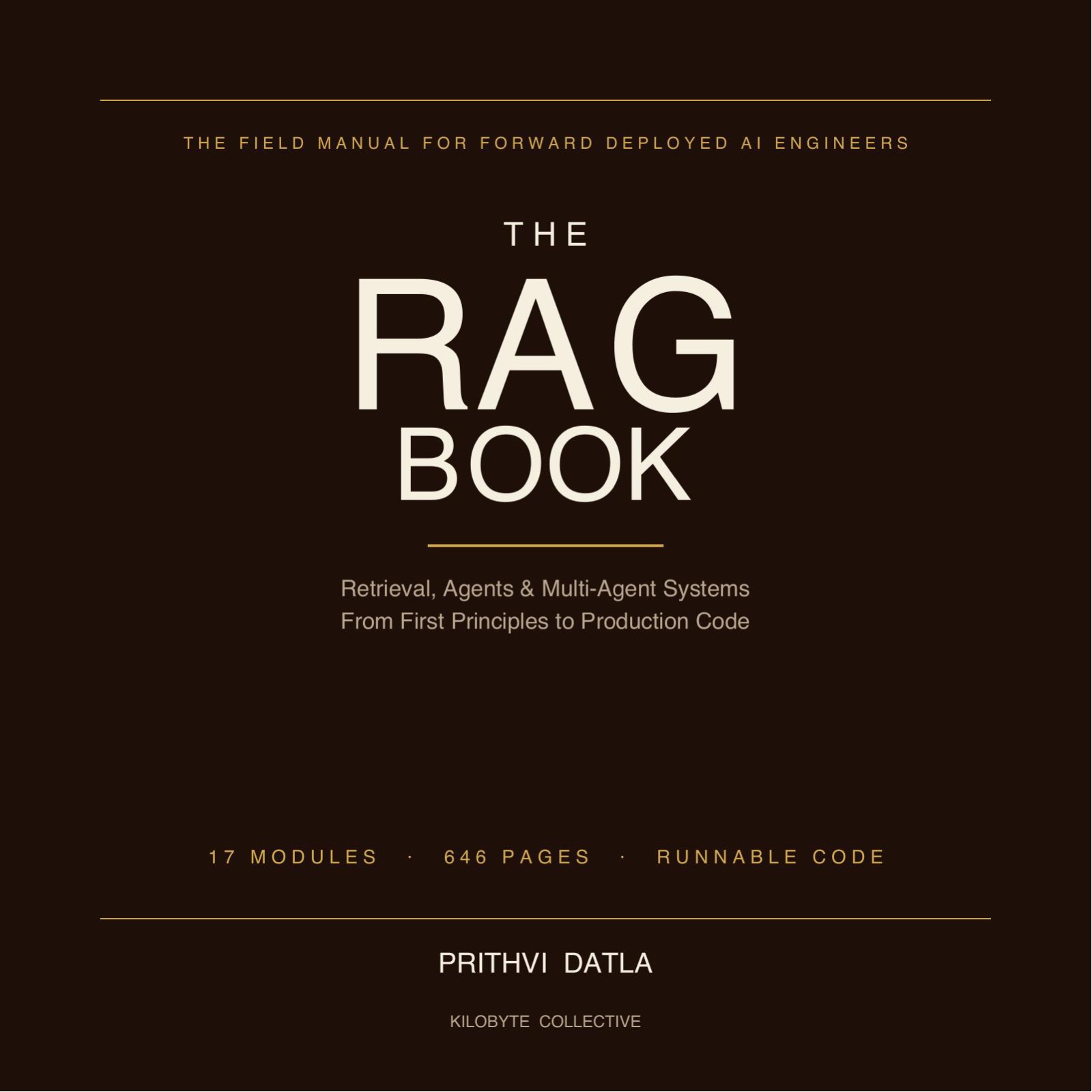
The RAG Book. A field manual for AI Engineers building Multi-Agent Systems.
17 modules, laid out as a 10-day program. Every concept explained from two angles in the same pages — product (what it does, what it affects, when it fails) and engineering (how to build it, how to test it, how to ship it). Every module opens with a real production failure. Runnable Python throughout.
Cost to complete the book, API calls included: $11.
PDF Only: 646 Pages, Product + Engineering Tracks + Runnable Code - $59
Labs Bundle: All of the Above + 3 Labs + Captsone (Git Access on purchase) - $109
Preview it here for FREE: